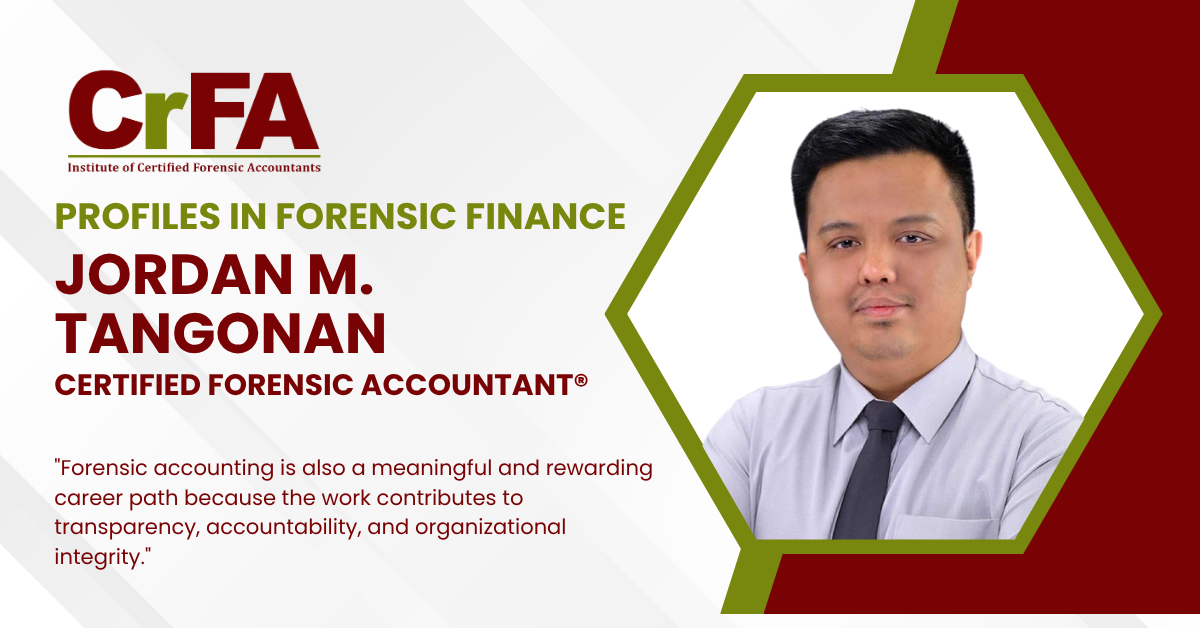
Jordan M. Tangonan, CrFA®, is a results-driven finance professional whose work integrates financial analysis, investigative rigor, and strategic business insight. His Certified Forensic Accountant (CrFA®) designation validates his specialized capability to detect financial irregularities, analyze complex transactions, and support organizational integrity through forensic methodologies.
With a foundation in management accounting and accounting technology, his fascination with numbers and financial decision-making began early and evolved into a professional commitment to understanding both the analytical and strategic dimensions of business. Through his CrFA® credential and his deep interest in how financial decisions impact businesses and individuals, he exemplifies the qualities of a meticulous, analytical, and strategic forensic professional dedicated to uncovering the truth and safeguarding financial integrity.
CRFA Certification Story
Inspiration to Pursue CrFA Certification
“What inspired me to pursue certification with the Institute of Certified Forensic Accountants was my growing interest in understanding the deeper meaning behind financial information and business activities. While many accounting certifications focus primarily on technical reporting and compliance, forensic accounting aligned more closely with my passion for investigation, analysis, and uncovering the story behind the numbers.
I also recognized that forensic accounting is a rapidly growing field, especially with the increasing complexity of fraud, financial misconduct, and regulatory concerns in today’s business environment. At the same time, I wanted to pursue a specialization that genuinely matched my interests rather than simply following a more mainstream path.
For me, numbers without context or meaning feel incomplete. I have always believed that financial data tells a story — whether it reflects business performance, operational issues, risk exposure, or even fraudulent activity. What drew me to forensic accounting was the opportunity to connect financial analysis with investigation and human behavior, allowing me to look beyond the figures and understand the real situation behind them.
Pursuing the Certified Forensic Accountant® credential strengthened both my technical and investigative perspective, while also reinforcing my commitment to integrity, critical thinking, and professional growth in this field.”
Preparation Challenges and How They Were Overcome
“One of the most challenging parts of preparing for the Institute of Certified Forensic Accountants certification was balancing my preparation while already working as a professor teaching accounting, finance, management accounting, and related business subjects. Teaching itself required extensive preparation, continuous studying, and the responsibility of ensuring that students fully understood complex concepts, so managing both academic responsibilities and certification preparation was demanding.
Another challenge was shifting from a purely academic and instructional perspective into the more investigative and analytical mindset required in forensic accounting. While my background in accounting and finance provided a strong technical foundation, forensic accounting required deeper focus on fraud detection, investigative procedures, risk assessment, and critical analysis of evidence and irregularities.
I overcame these challenges through discipline, effective time management, and genuine passion for the field. I maximized my teaching experience by connecting theoretical concepts with practical forensic applications and real-world cases. At the same time, my role as an educator strengthened my ability to analyze situations critically and communicate complex ideas clearly, which became valuable during my certification preparation.
What kept me motivated was my belief that numbers should always have meaning and context behind them. For me, accounting is not only about calculations and reports — it is about understanding the story behind the figures, identifying risks, and uncovering the realities that financial information may reveal.”
Credibility and New Opportunities After Certification
“Earning the Certified Forensic Accountant® designation from the Institute of Certified Forensic Accountants significantly enhanced my professional credibility by strengthening both my technical expertise and professional confidence in the field of forensic accounting. The certification validated my knowledge and skills in fraud investigation, financial analysis, and valuation, which helped establish greater trust and credibility with clients and professional connections.
It also opened new opportunities professionally and financially. After obtaining the designation, I was able to connect with more clients and become involved in engagements related to fraud cases, document verification, investigations, and valuation work. These experiences provided immediate practical exposure to real-world forensic accounting situations, which further developed my analytical and investigative skills.
In addition, the certification helped differentiate my professional profile because forensic accounting remains a growing and specialized field. It allowed me to combine my background in accounting, finance, teaching, and talent acquisition with investigative and valuation-related work, creating broader career opportunities and professional growth.
Overall, the ICFA® designation not only enhanced my credentials, but also expanded my professional network, increased opportunities for meaningful engagements, and strengthened my ability to contribute value in areas involving fraud detection, investigations, and financial analysis.”
Impact on Fraud Prevention, Detection, and Investigation
“The Certified Forensic Accountant® certification from the Institute of Certified Forensic Accountants helped me contribute more effectively to fraud prevention, detection, and investigation by strengthening both my technical knowledge and investigative approach. It provided me with deeper understanding of fraud indicators, financial analysis techniques, investigative procedures, and risk assessment methods that are essential in identifying suspicious activities and inconsistencies.
The certification also enhanced my ability to approach cases with a more structured and evidence-based mindset. In my professional experience, especially in background verification and compliance-related work, I encountered cases involving falsified documents, identity misrepresentation, fabricated records, and other irregularities. Through the knowledge and perspective gained from the certification, I became more effective in analyzing patterns, validating information, and identifying potential red flags before they could create larger organizational risks.
In addition, the certification improved my confidence in handling sensitive investigations and communicating findings professionally and objectively. It reinforced the importance of maintaining integrity, confidentiality, and proper documentation throughout the investigative process.
Beyond investigations, the certification also strengthened my ability to contribute to fraud prevention by helping organizations identify weaknesses in processes and internal controls. Instead of only reacting to issues after they occur, I became more focused on proactive risk management and promoting accountability and transparency within organizational systems.”
Advice to Finance Professionals Considering Forensic Accounting
“My message to finance professionals considering a career in forensic accounting is to stay curious, analytical, and open to looking beyond the numbers. Forensic accounting is a field that goes deeper than traditional accounting because it combines finance, investigation, critical thinking, and problem-solving. It is not only about identifying discrepancies, but also about understanding the story, behavior, and risks behind financial information.
I would encourage aspiring professionals to continuously develop both their technical and investigative skills. A strong foundation in accounting and finance is important, but equally valuable are communication skills, attention to detail, ethical judgment, and the ability to analyze situations objectively. As fraud and financial crimes become more sophisticated, especially in today’s digital environment, the demand for professionals who can detect and prevent these risks continues to grow.
Forensic accounting is also a meaningful and rewarding career path because the work contributes to transparency, accountability, and organizational integrity. In my experience, it has provided opportunities for continuous learning, professional growth, client engagement, and practical exposure to real-world cases involving fraud, investigations, and valuation.
Most importantly, I would remind them that numbers should never be viewed as figures alone. Every financial record tells a story, and forensic accounting gives professionals the opportunity to uncover the truth, protect organizations, and create value through integrity and critical analysis.”