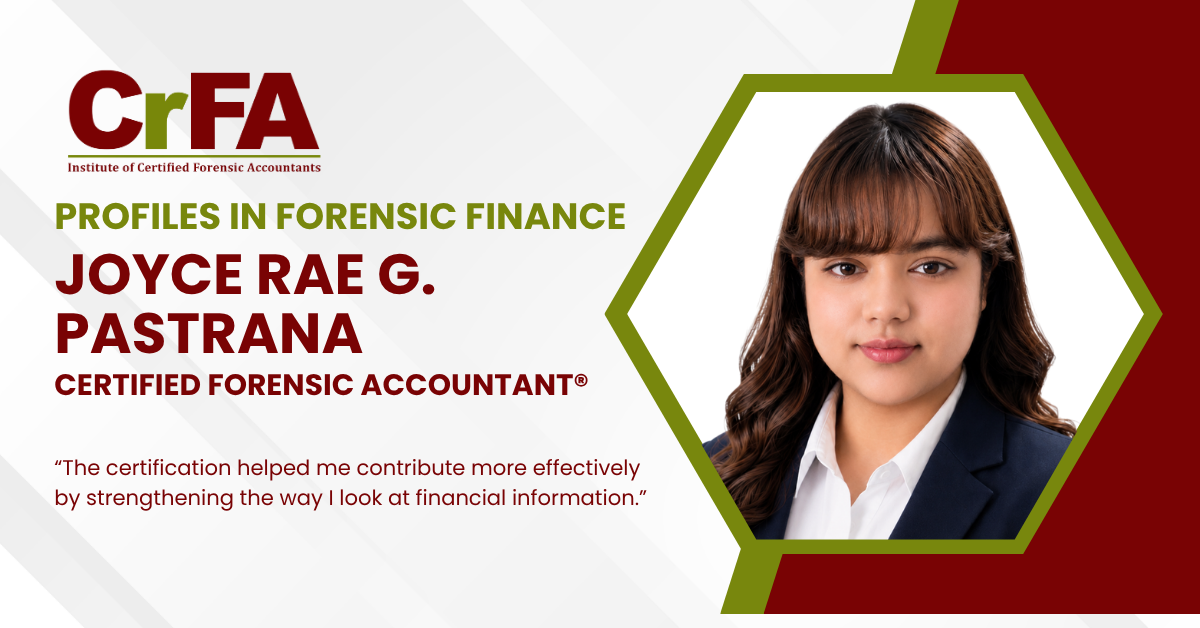
Joyce Rae G. Pastrana, CrFA®, is a forensic accounting professional whose career began in government accounting, where she gained valuable experience in core accounting and financial reporting functions within the public sector. Her Certified Forensic Accountant (CrFA®) designation reflects her specialized expertise in investigating financial irregularities, strengthening internal controls, and promoting accountability and transparency.
CRFA Certification Story
Motivation for pursuing ICFA® certification
“What inspired me to pursue certification with the Institute of Certified Forensic Accountants (ICFA®) was the desire to prepare myself for the next chapter of my career. At the time, I was transitioning from my experience in government accounting toward a path more closely aligned with audit, accountability, and public trust. Taking the CrFA program felt like a meaningful step to strengthen my perspective beyond regular compliance and reporting.
More than just earning another credential, I saw the certification as an opportunity to develop a more investigative and evidence-based mindset. I wanted to better understand how forensic accounting can help in fraud prevention, detection, internal controls, and ethical governance. It aligned with the kind of professional I aspire to become: someone who is technically competent, principled, and committed to promoting transparency and accountability.”
Biggest challenge in preparation and how it was managed
“The most challenging part of preparing for the ICFA® certification was balancing it with everything else happening in that season of my life. I was managing work responsibilities, personal commitments, and career transition plans, so there were times when studying felt overwhelming. What helped me was treating the preparation as part of my growth, not just as another requirement to finish.
I overcame it by staying consistent, managing my time better, and reminding myself why I started. I focused on understanding the concepts rather than simply memorizing them, especially because forensic accounting requires judgment, analysis, and critical thinking. Looking back, the challenge made the achievement more meaningful because it reminded me that growth often happens during busy and uncomfortable seasons.”
Credibility and opportunities after earning the designation
“The ICFA® designation enhanced my professional credibility by showing my commitment to continuous learning and to a more specialized area of the accounting profession. As a CPA, earning the CrFA credential helped broaden my professional identity beyond traditional accounting and financial reporting. It also strengthened the way I present myself as someone who values accountability, internal controls, evidence-based analysis, and ethical practice.
In terms of opportunities, the designation gave me more confidence as I move toward a career path more closely aligned with audit and public accountability. It opened my perspective to roles and responsibilities where forensic thinking is valuable, especially in identifying risks, asking the right questions, and looking beyond the surface of financial information. More than the title itself, the certification helped me become more intentional about the kind of professional I want to be.”
Impact on fraud prevention, detection, and investigation
“The certification helped me contribute more effectively by strengthening the way I look at financial information. It trained me to be more mindful of red flags, supporting documents, internal controls, and the overall reasonableness of transactions. It also helped me appreciate that fraud prevention and detection are not only about finding errors, but about understanding patterns, risks, and weaknesses that may allow irregularities to happen.
It also improved my confidence in applying a more investigative and evidence-based mindset in my work. I became more intentional in asking the right questions, reviewing records carefully, and looking at transactions beyond face value. For me, the CrFA certification reinforced the importance of being both analytical and ethical, especially in work that involves accountability, transparency, and public trust.”
Message to finance professionals considering forensic accounting
“My message to finance professionals considering forensic accounting is to stay curious and not be afraid to explore a more investigative side of the profession. If you are someone who values truth, details, fairness, and accountability, forensic accounting can be a meaningful path. It allows you to use your technical knowledge not only to prepare or review numbers, but to understand the story behind them and help protect organizations and stakeholders.
You do not have to know everything at the beginning. What matters is the willingness to keep learning, ask the right questions, and develop both competence and integrity along the way. Forensic accounting is a field where your skills can create real impact, especially in promoting transparency, preventing fraud, and strengthening public trust.”